






Why you need a force majeure clause [+ free template]
Start a Trial

HoneyBook member and attorney Paige Griffith provides a force majeure clause template you can add to your contracts to protect your business during unexpected events, such as natural disasters and pandemics like COVID-19.
Unexpected situations happen all the time — from pandemics to natural disasters. We all hope businesses can keep moving, but sometimes these events prevent them from being able to perform their obligations.
In law, these interruptions are considered force majeure events, which translates from French to “greater force.” These unforeseeable events are beyond all parties’ control — including business owners, employees, vendors, and clients. Although it sounds like it should be, force majeure isn’t implied in common law. Instead, you’ll need to provide express protection for your business. Including a force majeure clause in your contract can help you accomplish this.
If you work in live events, this clause can protect you and your business from situations like floods, earthquakes, civil disorder, and more. Even if you don’t work events, the same clause will protect your normal workspace if any operating issues, including compromised internet connectivity, affect regular production.
What is the value of a force majeure clause?
The main value of a force majeure clause lies in its ability to mitigate risks, provide legal protection, offer flexibility, and contribute to the smooth functioning of contracts in the face of unpredictable events.
Including a force majeure clause in contracts is vital for both you and your clients to manage operations when unforeseen and uncontrollable events occur. It offers protection that allows everyone to suspend or terminate performance obligations without being held liable for breach of contract when faced with events beyond their control.
With the clause in place, all parties can plan in advance for force majeure outcomes and avoid unforeseen surprises, disagreements, or messy legal proceedings in the aftermath.
What is a force majeure clause?
A force majeure clause includes three elements:
- It specifies the events which enable either party to declare a force majeure/act of God event.
- It states how a party should notify its counterparty about the occurrence.
- It describes the consequences after a force majeure event has occurred.
Essentially, force majeure clauses should apply to each party in the agreement, excusing them from fulfilling their contractual obligations during an unexpected event beyond their control.
Attorney and HoneyBook member Paige Griffith of The Legal Paige recommends modifying or adding three significant clauses into your existing contract templates to protect your business:
(2) Safe working environment clause
(3) Failure of company to perform services clause
“Most often I see contracts missing parts 2 and 3 in their force majeure clause,” says Paige. That means that many businesses fail to include how they’ll notify their clients about a force majeure event, as well as the consequences after a force majeure occurs. Be sure to consult with your business attorney so you can ensure these specific terms are included in your contracts.
See the photography contract example below.
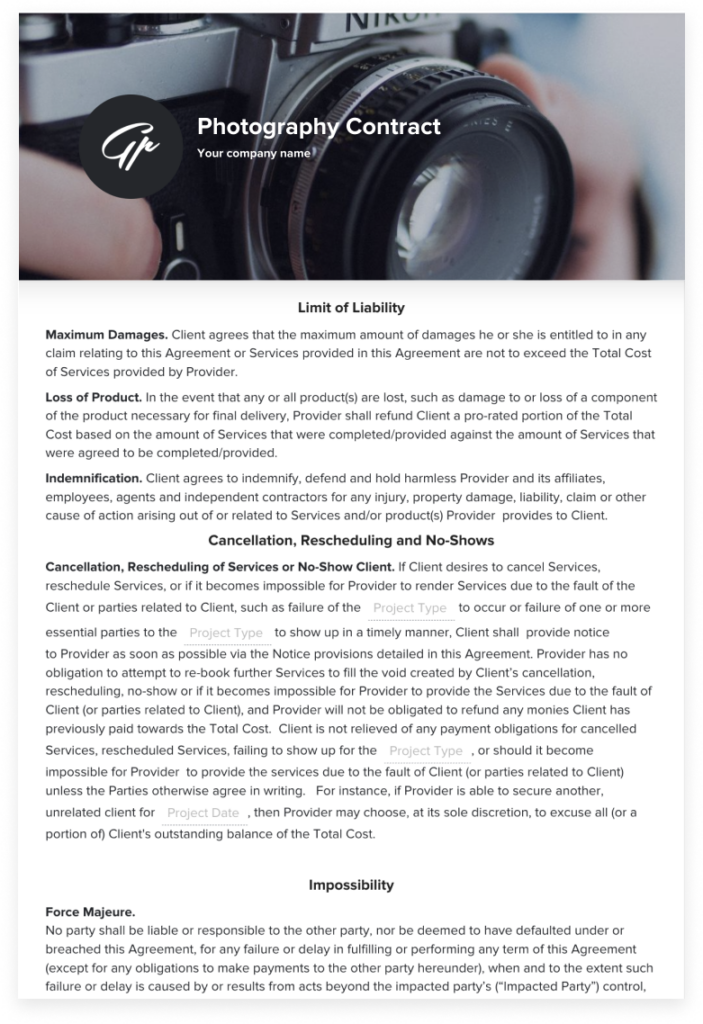
Need a force majeure clause for your business contracts?
Copy and paste the force majeure clause sample language below into your existing contract templates. Make sure to update the bolded fields.
Explore the HoneyBook Template Gallery for a variety of contract templates that can inspire you and help you create professional, streamlined contracts, proposals, and more to enhance your client experience.
RELATED POST
How to handle a client who wants to cancel a contract

Is the COVID-19 pandemic considered a force majeure event?
Since the pandemic, many people have been wondering about its effect on existing contracts. Griffith says, “People should be sure to spell out that ‘epidemics and pandemics’ are included as qualified force majeure events, and indicate the number of days following the force majeure event that the other party may terminate and the remedies allowed.
Since 2021, the COVID-19 outbreak and its consequences are no longer fully unpredictable and may not qualify as a ‘force majeure event’ in contracts that are entered into right now. Be sure to have other clauses in place such as a ‘safe working environment clause’ and ‘failure of company to perform services clause’ to protect yourself in case the force majeure clause is not applicable.”
What are other examples of force majeure events?
A force majeure provision can apply to public health emergencies like pandemics and epidemics as well as other events out of each party’s control. If any of these events occur, it releases the service provider from their performance obligations.
- Economic conditions like strikes
- Governmental actions like war and invasion
- Environmental/natural disasters like storms, floods, and fire
- Infrastructure failures like transportation and energy disruptions
What happens without a force majeure clause?
Without a force majeure provision in your contracts, you may still be able to use common law doctrines to determine how to handle interruptions or events that are out of your control. However, you’ll need to do your due diligence to understand if and how these common law doctrines apply within different states:
- Doctrine of impossibility: This may excuse the service provider’s performance if their principal purpose is impossible to complete due to unforeseen circumstances. When using this doctrine, the service provider must show that an unforeseen event or circumstance would produce significantly different results than expected.
- Doctrine of frustration: This may excuse the service providers’ performance when a substantial and fundamental change in circumstances renders the contracted action impossible, illegal, or significantly different from what was initially anticipated.
Keep your business legally protected
A force majeure clause is just one piece of an ironclad contract. You need a robust contract management process that can address the entire contract scope and protect your business through all types of scenarios.
HoneyBook’s contract templates offer a quick, easy, and efficient way to create customized contracts. Designed by legal experts, HoneyBook templates can be tailored to meet specific needs, saving independent business owners the time and the stress of having to create something from scratch. Professional-looking templates increase the attention of the audience and burnish the brand.
Once you have your contracts and clauses in place, use a clientflow management platform that will help you organize and customize your contracts according to your exact specifications.
You’ll be able to send your contract and invoice at the same time, so your clients are clear on all your expectations and boundaries before moving forward with payment. Furthermore, you can send automated reminders for your contracts if your clients need to be nudged to move forward with contract signing.
By keeping your clients professional and organized, you can stay protected as you move forward with booking.

Protect your business
Use HoneyBook’s ironclad contract templates to protect your business and clients.
Get startedDisclaimer: This force majeure clause template is provided for your convenience to help protect your business and minimize the impact from COVID-19 and other types of health emergencies and natural disasters as part of a business continuity plan for small business. We consulted with attorney Paige Griffith, J.D., of The Legal Paige, who wrote the Force Majeure clause. While a professional was consulted, this is not provided as a substitute for legal advice. If you have any questions about this template or your finished contract as it relates to your specific business, please contact a licensed attorney.

HoneyBook's client relationships platform makes it easy for independent business owners to streamline their processes and create remarkable client experiences by combining essential tasks like an online contract, online invoice, client communication, online payment software, and more all in one place.

Subscribe to the HoneyBook newsletter for the latest and greatest business practices.